
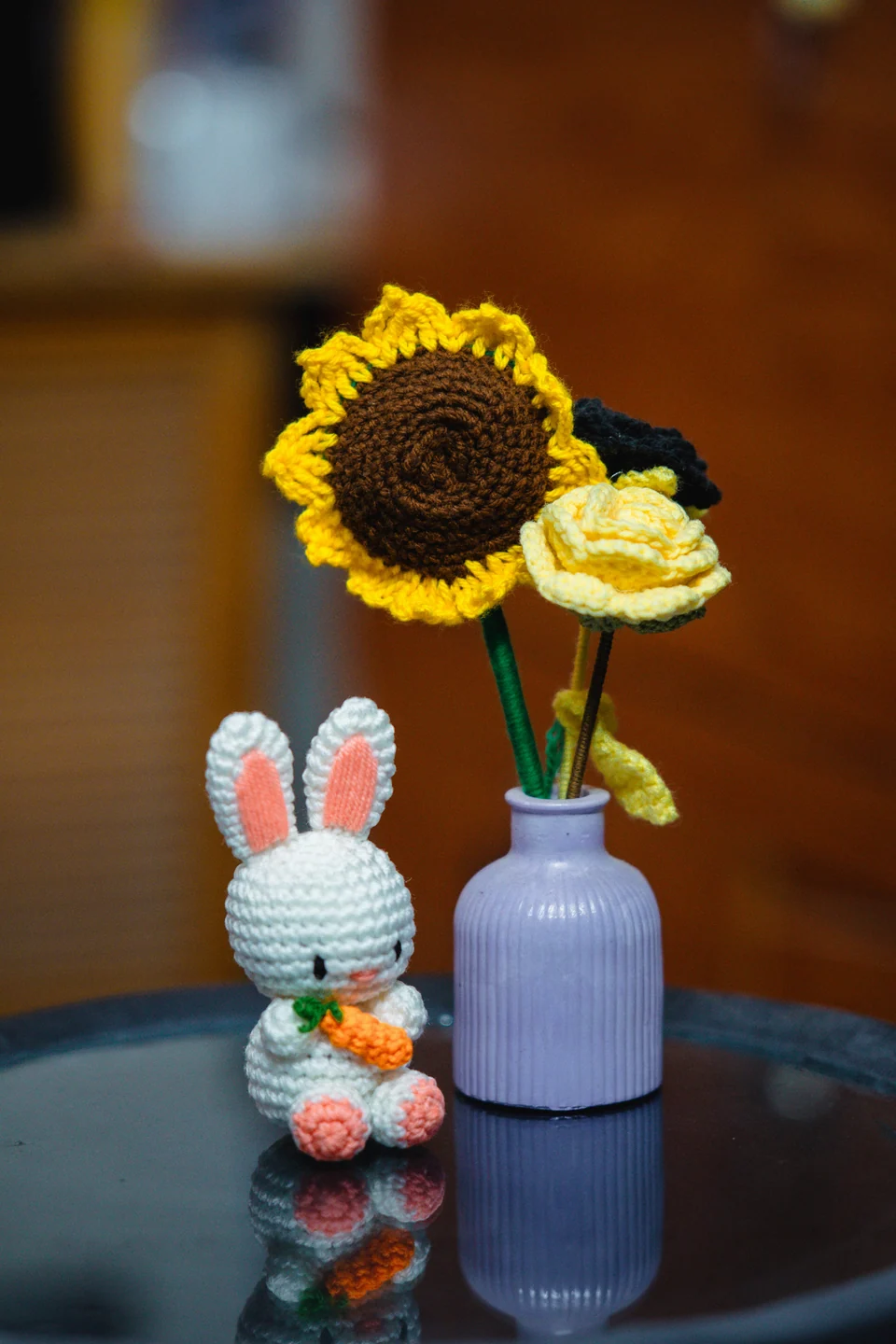
About This Generator
The Amigurumi Creature Generator builds defined bear, rabbit, cat, penguin, fox, frog, dinosaur, original dragon and owl constructions, plus a cat/frog/penguin collection from explicitly described spiral components. It is useful for learning how head size affects the body, how repeated small parts are counted, and how assembly determines the character's appearance. It is intended for crocheters who can work tight sc, increase, decrease, and sew parts securely. It is not an unrestricted animal designer: each named study has its own component list, shaping, attachment anchors and embroidered expression. It does not infer unrestricted anatomy from a photograph.
How to Use This Generator
Creature construction selects the actual component model. Bear and Rabbit retain their original version-one recipes. Head increase rounds controls the expansion depth of the head, within the supported range of two through eight. New individual constructions require at least three head growth rounds, or four for dinosaur and dragon, and stop at eight. Other parts follow the construction's defined proportions; there are no independent sliders for every limb or feature. Choose the main and accent swatches, set US or UK terminology, and regenerate. Read the parts in their own local round numbering rather than treating the long combined list as one continuous round worked on a single object.
New constructions use four even head rounds and an open twelve-position neck matching the body rim. Their embroidery map uses the same head height and its actual widest band. Penguin adds a within-round contrasting belly band; Owl adds stepped facial color patches. Their stored single-crochet color operations, source charts and loop previews preserve those assignments. Fox changes its tapered tail from accent to main yarn after its first two rounds.
Written Pattern contains quantities, component finishes, and the assembly notes. Symbol Chart and Stitch Preview show unwrapped insertion structure, with a connection guide where available. Use the written attachment positions to orient the face before sewing. Save project retains a local draft. Export JSON preserves the creature choice and scale parameter; Export SVG supplies the structural reference. Print can produce a paper copy or browser PDF. Keep an exported file alongside any notes about actual yarn, hook, filling, and measured size.
Understanding the Crochet Pattern
A component increase consumes one old stitch and produces two sc. A decrease consumes two old stitches and produces one. The body and head grow through six sectors and include even rounds before their specified closure or open neck seam. Arms, ears, and other parts can remain open with a sewing tail. Spiral work requires a first-stitch marker; it does not use a joining slip stitch and turning chain after each circuit. Stuffing and closing are component-specific actions, not one identical instruction for every piece.
How the Generator Works
The head's increase rounds reach six times the selected expansion depth. The bear body uses the larger of two or one fewer than the head's increase depth, followed by its own even rounds. Rabbit adds its specific long ears, hind feet, and tail and uses its own assembly instructions. The component model checks that each round consumes the preceding round's count. Quantities are explicit: a displayed arm pattern may need two copies. Cat has small cone ears and a long tube tail; Fox has wider cone ears and a two-color taper. Frog has compensated-bend hindlimbs, while Dinosaur has three separate flattened back spikes. Original Dragon adds paired wings and horns, with no licensed-character claim. Owl has wing and foot components plus its actual head colorwork. Each flattened limb is paired and closed before its separate receiving seam. The collection preserves three independent part inventories and head expressions in one project; do not mix their graph references.
The code supplies embroidery positions and construction notes, but it does not measure proportions in centimeters or certify a finished toy.
Step-by-Step Worked Example
Choose Bear with 3 head increase rounds. The head grows through six, twelve, and eighteen sc. Three even rounds retain eighteen, then the decreases reduce to twelve and six before closure. The body expands to twelve because its supported increase depth is two, then follows its own four even rounds and closure. Make two ears, two arms, and two legs as listed, giving eight pieces altogether with the head and body. Stuff and close the appropriate parts, sew the head to the body's top, and attach paired limbs symmetrically before embroidering the face.
Download this worked example as JSON. Restore it in this generator to compare the actual counts and structure.
Practical Tips
Use a hook that produces firm fabric with your selected yarn, then check that filling does not show through. Keep paired parts beside each other while working to compare tension and length. Mark the front before sewing the head so the face and limb positions agree. Add filling gradually and inspect the shape before closing the last small opening. Keep an inventory of completed copies rather than counting pattern entries as completed pieces.
Common Mistakes and Solutions
The second arm is shorter despite matching round totals
Tension or filling may differ. Compare the unstuffed pieces, count the even rounds from their markers, and remake or adjust the inconsistent piece before attaching either arm permanently.
The head and body counts appear to be one continuous sequence
The component boundary was missed. Find the new part heading and its local Round 1, start a separate piece, and use its quantity and finishing instruction rather than crocheting it onto the previous part automatically.
The face ends up on the back
The front was not established before assembly. Pin the head and limbs temporarily, identify the intended front and tail position where applicable, then embroider and sew only after checking the complete arrangement.
Second Reproducible Application
Use this comparison to check how one input changes the amigurumi creature pattern generator output. Enter animal = bear; rounds = 4. Keep any grid and color data from the downloadable worked example unchanged. Generate again and compare the result with the first example above. The resulting dimensions are Original bear: 8 pieces; measure a swatch for physical size. These depend on the entered block size, not a measured finished sample. This comparison was executed with the site's engine; it is a numerical construction check rather than a claim about physical gauge. Save both settings separately if you want to compare them later.
Related Tools and Guides
The Tools directory at /generators/ lists the available generators. Use the linked examples on this page to study the same construction with different inputs, and the Guides directory at /guides/ for supporting reading. Check terminology and measured gauge before combining output from different tools.
Frequently Asked Questions
Which animals are actually generated?
The menu contains the defined bear, rabbit, cat, penguin, fox, frog, dinosaur, original dragon, owl and collection models. Each choice produces its actual supported parts and seams; it is not an unrestricted species or character generator.
Does increasing head rounds enlarge every piece proportionally?
No. Some parts follow fixed small-component rules, while the head and body use related expansion depths. Review every component after a parameter change instead of assuming uniform scaling.
Are parts joined as they are crocheted?
The supported construction makes separate components and supplies sewing instructions. Do not assume a continuous no-sew assembly route unless the actual output explicitly provides one.
Can I use detachable eyes for a young child's toy?
The supplied guidance uses embroidered features rather than detachable small parts for young children. Evaluate the whole finished object's materials and construction separately; the diagram is not a toy-safety certification.
Do the combined steps tell me the exact finished height?
No. They describe the component operations and assembly. Finished dimensions require the actual yarn, hook, stuffing, sewing tension, and a completed measured sample.